The basics of investment in Krakow.
Everybody is free to do business in Poland regardless of
nationality, and only in the case of a handful of sectors
deemed most sensitive to national security – i.e. more or
less the worldwide standard medley from defense industry to
TV – either there are certain restrictions or concessions
are required. At the same time no industry is closed to
private enterprise.
All companies incorporated
in Poland, no matter who owns them, are equal before the law
of the country. And the Polish competition law, the
protection of intellectual property, bankruptcy law, etc.
are nowadays up to the Western standards.
Since Poland is a full
member of the European Union the country's law incorporates
all basic principles of the community and most of the EU
directives.
Taxes in Poland
are usually lower than in other EU countries, except VAT that
amounts to 23 percent on most commodities and services.
Polish corporations can be owned altogether and run by foreign
shareholders.
Full repatriation of capital as well as after-tax profits and
dividend earnings is guaranteed.
Foreign investors may launch (or buy a share of) a limited
liability company or a join stock company – with Polish partners
or without. They may also establish a branch or a representative
office of some their enterprise incorporated elsewhere. As
regards branches, their scope of business is limited to the core
business of the parent company and their registration is
required, while they are subject to the same taxes as regular
companies.
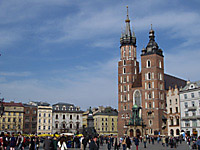
Rynek Glowny,
central square at
the heart of Krakow's Old Town historic district remains the city's social hub.
Tips for foreign investors:
1. You need a lot of patience in dealings with bureaucracy – in
Krakow as everywhere.
2. A knowledgeable native helper with connections can prove
pretty instrumental in cutting through the red tape.
|