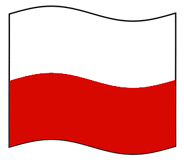
Poland
The Republic of Poland – Rzeczpospolita
Polska in Polish – lies in the very geographical center
of Europe between, clockwise from the north, the Baltic Sea,
Russia’s Kaliningrad enclave, Lithuania, Belarus, Ukraine,
Slovakia, the Czech Republic and Germany. Its area of
312,677 sq km (120,725 sq miles) and population of 38,6
million makes Poland a sizeable European nation on a par
with Spain and the key one in Central-Eastern Europe. It
also proves one of the world’s vibrant and open economies.
Poland joined NATO in 1999 and is the European Union's
member since May 1, 2004.
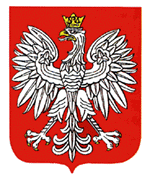
Visiting Poland
Poland ranks among the world’s ten
most visited countries, with the bulk of visitors coming
from the neighboring nations. Their numbers shot up in the
early 1990s, from 18 million in 1990 to 70 million in 1994
including day trips for shopping or business, and have
remained on rise ever since. Besides
Krakow, Poland’s ancient capital, the country’s prime
tourist attractions include beach resorts along the Baltic
Sea, the vast Mazury lake district to the northeast of
Warsaw, the Carpathian and Sudeten mountains, and many
historic sites as well as national parks with unspoiled
nature.
Poland’s major cities are the capital Warsaw (1,7 millions), Krakow (760,000); Lodz (750,000);
Wroclaw (650,000); Poznan (600,000); Gdansk (500,000); Szczecin
(420,000); Bydgoszcz (390,000); Katowice (370,000), Lublin
(360,000).
Weather
Poland's climate blends the moderate conditions of Western
Europe with the more severe continental ones of Eastern Europe.
Notably winters seem erratic. Average January temperatures are
-1C (30.2F) in the west and -5C (23F) in the southern mountains.
Average summer temperatures are about 20C (68F) in the southeast
and about 17C (63F) on the Baltic coast. Heat above 40C and
froze below 30C just happen. Average annual precipitation totals
as little as 61 cm (ca 24 in), but it reaches 150 cm in the
mountains. Winter precipitation is half the summer rainfall.
Gales occur rarely. No cyclones, earthquakes, volcanoes, etc.
Poland's Geography
Poland stretches between 49°00’N (Opolonek mount) and 54°50’N (Rozewie
peninsula), and between 14°07’E (Odra river near the town of
Cedynia) and 24°08’E (Bug river near the town of Strzyzow).
The northern two-thirds of Poland is a vast region of plains.
Its Central Lowlands are crossed from east to west by a
succession of large, shallow valleys. Baltic Heights, dotted
with hills and lakes, lie north of them. The narrow Coastal
Plain, still further north, runs almost the whole length of the
Baltic Sea’s Polish shore. The coastline of 694 km is largely
regular save the Pomeranian Bay in the west and the Gulf of
Gdansk in the east.
Poland’s southern one-third comprises various upland areas with
intervening lowlands and a belt of mountains in the very south
and southwest. The Western Carpathian mountains include the
alps-like High
Tatra Mountains
with the country’s highest peaks and the Beskids. The southwest
Sudeten Mountains top elevation is just 1602 m. North of the
mountains are a zone of foothills, the Silesian Plain, the
Little Polish Upland, and the old and low Swietokrzyskie
Mountains.
The Vistula (Wisla) and Oder (Odra) rivers are Poland’s biggest
by far and traverse it lengthwise from the south to the north.
The country boasts some 9300 lakes of one hectare or more,
mostly scattered across the Baltic Heights, the Coastal Plain,
and the Mazury region, where two lakes, Sniardwy and Mamry,
surpass 100 sq km in size. There are also some 120 artificial
reservoirs, chiefly in the Baltic Heights and in the southern
mountains.
Poland's Wildlife
Forests take up some 28% of Poland’s territory, and they are 80%
either spruce or pine. Yet one finds in the northeast region
such scarce species as dwarf birch and Lapp willow, unique in
Europe. Most wildlife looks typical to Europe, but Poland also
boasts animals either unique or extremely rare
elsewhere–European bison, tarpan wild horse, bear, chamois,
lynx, wildcat, wolf, elk, boar, and deer. European bison (zubr)
live in the Bialowieza National Park, Europe’s vastest forest,
on the border of Belarus. Wolves and brown bear are found in the
mountains, while elk and deer are pretty common by the lakes.
Grouse, heathcock, and black stork dwell in farmlands, lake
marshes, and forests in the north. Lakes, rivers and streams
provide habitat to ample fish.
Currency:
1 zloty (PLN) = 100 groszy.
Exchange rates of the major world currencies as of November 2021
- 4.7 zlotys for one euro, 4.2 PLN for one US dollar, 5.6 zlotys
for one British pound, and 4.5 zlotys for one Swiss franc.
Time: CET as Berlin or Vienna, i.e. GMT/UTC
plus one hour.
Electricity: 230 volts, 50 Hz AC
Weights & measures: Metric
|
More Poland data
Poland's history
Poland's map
Information about Krakow, Poland
National
holidays in Poland
|